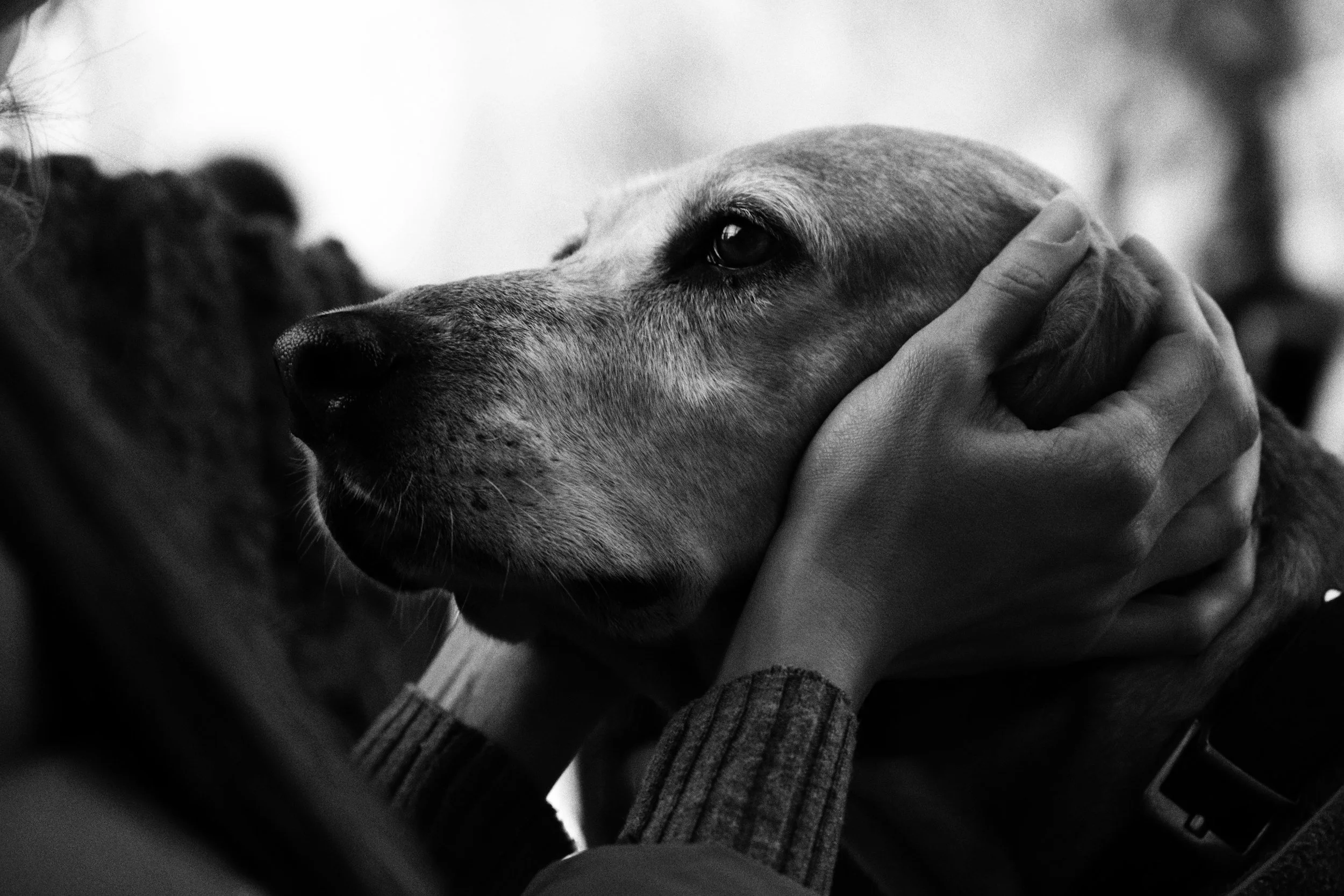
You’re doing the best you can — and you didn’t fail your animal.
Specialized therapy for pet loss, complex behavioral caregiving, and animal-related grief.
Offering online individual therapy to pet parents, veterinarians, and animal care professionals throughout Maryland and Washington, DC.
This narrative often grows in moments of uncertainty, limited options, conflicting advice, and impossible choices. How might this narrative change if the stories of grief were understood as a meaningful response to love—rather than something to be fixed because it was “too much” or “not enough?”
Naming the quiet part.
When something painful happens with an animal we love, many of us carry a story that reads:
“I failed my pet.”
WHERE LOVE, LOSS & CAREGIVING IS HELD
-
WHERE LOVE, LOSS & CAREGIVING IS HELD -
OFFERINGS
My Approach to Grief Therapy:
This work requires care that is both specialized and deeply attuned. My work is grounded in narrative therapy and shaped by trauma-informed, compassionate, and inclusive care. I support people whose lives are shaped by deep bonds with animals—and the grief that can come with caring, deciding, and letting go. This includes pet loss and anticipatory grief, caregiver fatigue, and the quiet exhaustion that can accompany loving an animal through prolonged illness or uncertainty. While I support many forms of animal-related grief, behavioral euthanasia and complex behavioral caregiving are areas of particular depth and focus within my practice. I work with pet parents, veterinarians, and animal care professionals navigating the cumulative and emotional weight of this type of love and work.
Rather than focusing on “moving on” or finding closure, we slow down and center the stories that formed in moments of love, pressure, and uncertainty. Together, we gently examine these stories—separating who you are from the weight of blame, shame, or judgment that may have attached itself to difficult decisions or outcomes.
This approach is especially supportive for forms of grief that are often misunderstood or minimized. My training in veterinary social work further informs this work, allowing me to hold both the emotional complexity of the human-animal bond and the systems, expectations, and ethical pressures that surround it.
Therapy here is not about grieving “correctly,” but about making space for your story—so it can be held with context, dignity, and care.
Common Concerns I Support
-
Considering or grieving behavioral euthanasia
Living with a pet with severe or high-risk behavioral challenges
Rehoming/surrendering decisions
Pet loss and bereavement
Anticipatory grief
Sudden or traumatic loss
Chronic illness or medical care
Caregiver fatigue
Loss of a pet due to disappearance or theft
Loss of a pet due to divorce or breakup
-
Compassion fatigue and burnout
Grief from repeated euthanasia and patient loss
Moral distress/difficult care decisions
Financial limitations impacting care decisions
Workplace trauma
Conflict/difficult interactions with clients
Perfectionism and the pressure to get it right
Work-life balance challenges
Difficulty setting boundaries
Depression, anxiety, thoughts of suicide
THE PROCESS
Honoring your pace

01
INITIAL CONSULTATION
We begin with a conversation to understand your unique story and what you’re carrying.

02
TAILORED THERAPY PLAN
Together, we create a therapy plan shaped around your needs, goals, and the stories you bring.

03
ONGOING SUPPORT
You receive ongoing support in a safe, nonjudgmental space as you navigate grief, decisions, and healing.

ABOUT ME
Hi, I’m Nicole
I come to this work also as someone who has loved and lost deeply. From my soul dog, to a foster-fail senior pitbull who taught me that grief and gratitude can coexist, to an orange kitty cat who expanded my heart in magical ways—my life has been shaped by the animals who have shared it with me. Now I have Rise, my rescue dog and love of my life, whose big emotions and even bigger reactions continue to teach me every day.
Bond and Loss Therapy is my love letter to them, and to the veterinarians and animal care professionals who hold space for both the grief and joy that come with loving animals.
Alongside my lived experience, I bring over a decade of practice as a licensed psychotherapist and hospice social worker, with a focus on attachment, trauma, and grief. I am also completing my certification in veterinary social work, furthering my commitment to supporting pet parents and animal care professionals through loss, difficult decisions, compassion fatigue and burnout, and the often-overlooked legitimacy of pet loss and grief.
In this heart-work and sometimes very hard work, I prioritize self-care to ensure I’m fully present for the clients that I serve. When I’m not practicing therapy, you can find me stargazing, enjoying a good podcast, sharing laughter with loved ones, planning my next road trip, and occasionally cleaning up something my dog destroyed. I’m a fan of coloring books, cooking competition shows, hiking trails, matcha, and love stories.
FAQS
Answering your questions
-
If you’re here, you’ve already taken a meaningful step. When you’re ready, here’s what happens next:
Click the “request a free consultation” button and complete the contact form on my website. You can also email or call me, if preferred.
I’ll respond within 1–2 business days to schedule a 20-minute consultation.
If it feels aligned for both of us to move forward, we’ll schedule your first session, and I’ll send the consent and intake forms for you to complete beforehand.
-
My fee is $210 per 50-minute session. I am a private-pay provider and do not bill insurance directly. I accept all major credit cards and health savings accounts (HSA/FSA).
I provide monthly superbills that you can submit to your insurance company for possible reimbursement. If cost is a concern, I’m happy to discuss options and resources to help make therapy accessible and equitable.
-
You don’t have to wait for a loss. Support is appropriate at any stage of the human–animal bond — during caregiving, crisis, professional strain, or after loss. If something feels heavy, overwhelming, or unresolved, that is reason enough to reach out.
-
The length of therapy varies based on your goals, your circumstances, and the support you’re seeking — whether you’re navigating the grief of losing a pet, processing difficult medical decisions, supporting a pet with ongoing behavioral challenges, or managing the emotional weight of working in animal care. Some people find brief therapy (4–6 sessions) helpful for focused support, while others continue with ongoing therapy for 3–6 months for adjustment periods, or a year or more to work through deeper grief, identity shifts, compassion fatigue, or long-standing patterns.
Sessions are typically scheduled weekly or every other week, depending on what feels most helpful for you.
In our early sessions, we’ll clarify your goals together and create a plan that feels supportive and realistic. Everyone’s process is unique, and you are always in control of the pace, frequency, and duration of therapy.
-
Veterinary social work is a growing specialty within social work that addresses the emotional and social dimensions of veterinary medicine. In this work, pet parents are supported as they navigate grief, anticipatory loss, and complex caregiving, as well as veterinarians and animal care teams experiencing burnout, compassion fatigue, and moral distress. At its core, veterinary social work supports the wellbeing of both the people who love animals and those who care for them professionally.
A PLACE TO BEGIN
Would it be helpful to talk this through in a place where your grief is understood?
When you’re ready, we can explore your story with safety and compassion—whether your grief is unfolding now or long after a loss.